(this blog is based on the introduction of my dissertation, which can be read here: https://repository.ubn.ru.nl/handle/2066/292966)
Studying psychology
In 2011, I started my psychology bachelor at the Radboud University (Nijmegen, The Netherlands) with the aim to learn more about psychopathology and clinical change. I had my doubts about this decision, because I also aspired to become an ecologist, but in the end, psychology appealed more to me than biology. In my first year, I found the psychology bachelor quite fun, although I did not learn much about psychopathology. In the second year, I had some courses about psychopathology, but they were not what I had expected. The courses were much less interesting than my mother’s stories of working with persons with psychosis. The things I did learn, about diagnostics, clinical questionnaires, and risk- and protective factors, were often either too pragmatic or common sense in my view. Overall, I did not feel like I was gaining a deeper understanding of psychopathology. In hindsight, I especially missed theories of psychopathology (cf., Borsboom, 2013). I lost interest in my study and mainly played guitar in that second bachelor year.
In the third year of the bachelor, the courses became more challenging with various theoretical models and journal papers to read (instead of handbooks), which, to my own surprise, motivated me very much to study. I learned many box-and-arrow models in cognitive neuroscience, psychobiology, and social psychology. I enjoyed reading empirical studies with carefully conducted experiments and, especially in the case of social psychology, sometimes rather funny study designs (e.g., will people buy more French wine if the supermarket plays French music?). The models I learned in these courses were complicated, but just simple enough to be nice ‘puzzles’ (I think this is called ‘the IKEA effect’ in social psychology). I was quite good at these puzzles and suddenly started to get high grades, which further motivated me. Most psychopathology courses were still largely descriptive, without such box-and-arrow models, and I slowly gave up on my initial ambition to study psychopathology. I became interested in psychological science, and at that time, I believed that the field to go for was neuroscience or social psychology, not psychopathology.
Over the course of the third year, I had two realizations which slightly bothered me in my newly found scientific interest. First, I had the feeling that the more components a model had, the better it seemed to apply to reality. For instance, I recall a model of emotion-processing, where a 2-dimensional model was extended into a 3-dimensional one, which then could explain more phenomena. Extending 2-D into 3-D is quite comprehensive, as you can still visualize and intuitively understand such a model, but I got worried: wouldn’t then a 4-D model be better, or a 5-D, or a 6-D? For psychological phenomena, one can always find new relevant components to add to the model. I was afraid that our inability to think (and visualize) in high dimensions would be a ceiling to the scientific explanations that could be made in psychology. The second thing that bothered me was that all the models and results I learned did not seem to converge. For instance, I took the course Neurophysiology of Cognition and Behaviour, which sounded very fundamental to me, but did not have an overarching fundamental theory to connect the topics discussed in the separate lectures. Although the lack of convergence and integration was a bit disappointing, it did not bother me too much at the time. I believed that integration (at least in my own thinking) would surely come when I learned more. I was wrong.
After my bachelor, I was on the board of a cultural organization for a year, and then started the research master behavioural sciences with good spirits. In the opening week, we had a course about the ‘state of the art’ of behavioural sciences, led by the philosopher Jan Bransen. In his lectures, Jan was quite critical of social sciences. I do not know to what extent I understood the arguments he was making, but his ideas somehow resonated with me. At the end of one of his lectures (I think it was the last one of the course), Jan showed us a picture that has strongly influenced my view of psychological models ever since: the Rube Goldberg machine (Figure 1).
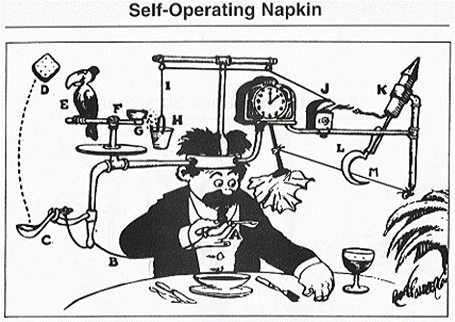
Figure 1.
A Rube Goldberg Machine
Note. Caption from https://en.wikipedia.org/wiki/Rube_Goldberg_machine “Professor Butts and the Self-Operating Napkin (Originally published in Collier’s, September 26, 1931). Soup spoon (A) is raised to mouth, pulling string (B) and thereby jerking ladle (C), which throws cracker (D) past toucan (E). Toucan jumps after cracker and perch (F) tilts, upsetting seeds (G) into pail (H). Extra weight in pail pulls cord (I), which opens and ignites lighter (J), setting off skyrocket (K), which causes sickle (L) to cut string (M), allowing pendulum with attached napkin to swing back and forth, thereby wiping chin.”
Psychological models and the self-operating napkin
According to the Wikipedia page, a Rube Goldberg Machine is ‘a chain reaction-type machine or contraption intentionally designed to perform a simple task in an indirect and (impractically) overly complicated way’. The term refers to the creations of a cartoonist, Rube Goldberg, who drew most of his machines in the beginning of the 20th century. The Wikipedia page also says: ‘Over the years, the expression has expanded to mean any confusing or overly complicated system´ and ‘[…] even scientific hypotheses deemed to be overly complex have been described by referencing such machines’. Indeed, during Jan’s lecture, he playfully suggested that this was perhaps what we were doing in psychological experiments. I was struck. I immediately saw the resemblance with the box-and-arrow psychological models, the ‘puzzles’ that excited me so much in the beginning of my 3^rd^ Bachelor year. The Rube Goldberg Machine that Jan showed us made me suddenly view most psychological models as absurd as a self-operating napkin (Figure 1).
Let’s illustrate the similarity I saw between Rube Goldberg Machine and psychological models by looking at Rube Goldberg’s self-operating napkin (Figure 1) and the reflexive-impulsive model (Figure 2) by Strack and Deutsch (2004), which is a typical example of the kind of models I learned about in my studies. The reflexive-impulsive model aims to explain how perception leads to behavior via two possible pathways (reflection vs. impulse). In relation to the Rube Goldberg Machine, I focus on the reflexive pathway of the model, which illustrates how perception is turned into ‘reasoned action’.
Figure 2.
Reflective-Impulsive Model. Reprinted from Strack and Deutsch (2004).
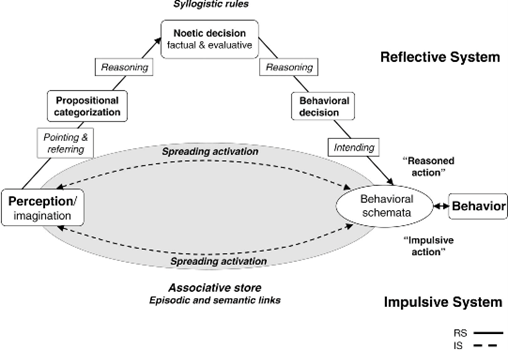
Note. Overview of the reflective–impulsive model. Note that reflective and impulsive processes are represented by solid or broken lines, respectively.
The Rube Goldberg Machine and the reflexive pathway of the reflective-impulsive model are similar in various ways. First, in both cases, a serial chain reaction of factors is triggered by a certain input (bringing a spoon to the mouth or perceiving a stimulus, respectively) that leads to a certain output in the end (a napkin wiping the chin or the activation of a certain behavior respectively). There are no further interactions between components. Second, the causal architecture of both the machine and the model is static and hard-assembled: there is only one way to get from taking a spoonful of soup to the napkin wiping the chin, and there is only one way to get from a perception towards a reasoned action. The process should work in the same way each and every time. Understanding the mechanisms underlying the self-operating napkin or reasoned action thus requires an explanation of the functioning of the separate components. A last commonality is that the more components one adds between the input and output, the more complicated the model becomes, which is of course the fun of a Rube Goldberg machine.
There are also some important differences between the Rube Goldberg machine and psychological models like the reflexive-impulsive model. The Rube Goldberg machine has directly observable components, while the components of the reflexive-impulsive model (e.g., ‘reasoning’) are not directly observable. The Rube Goldberg machine has a clear mechanism in the form of Newtonian physics, which explains how the machine should work. With one relatively simple mathematical formula, one should be able to know exactly how the force by which the soup-eater moves the spoon determines the force by which the napkin moves past the soup-eater’s mouth (assuming that the toucan always has appetite for a cracker). In psychological models, the mechanisms by which the components influence each other are generally unknown. Lastly, the methodology to study the components of a Rube Goldberg machine or a psychological model like the reflexive-impulsive model are vastly different. For the Rube Goldberg machine, one can literally isolate components to determine the causal architecture of the machine. In the reflexive-impulsive model, one cannot directly isolate the different components, but has to infer their role by experimental manipulation and/or statistical inference.
What struck me as a problem for psychological science was not necessarily the similarity between a Rube Goldberg machine and a psychological model, but especially these differences. The ‘invisible’, non-separable components and lack of directly inferable causal mechanisms in psychological models makes that empirical studies require many (currently) untestable auxiliary assumptions and thus cannot unambiguously evaluate a psychological model. Negative results can then always be attributed to possibly violated auxiliary assumptions, which makes it rather hard (or even impossible) to corroborate or falsify a hypothesis (cf., Hasselman, 2015; Meehl, 2004; Oude Maatman, 2021). Moreover, psychology’s replication crisis, which was at a peak moment at the start of my research master (Klein et al., 2018), made me view the empirical results that were supposed to support psychological models not only as quite far-fetched (because of the indirect inference), but also potentially untrustworthy. But apart from these methodological problems, that may in principle be solvable, the comparison with a Rube Goldberg machine made me feel that there was something fundamentally wrong with the general architecture of box-and-arrow type psychological models. I felt that the science of such models was somehow detached from the ‘real world’, and this bothered me tremendously.
More components, interactions and the issue of integration
Of course, psychological models are abstractions, and I do not wish to insinuate that psychological scientists think that actual psychological phenomena result from simple Rube Goldberg Machine-like linear input-output models. For most psychological models, scientists would agree that different inputs can trigger different workings of the model. In reality there will always be more components playing a role than the model will fit. Moreover, different components will not only interact serially, but also in more complex ways. This can for example be seen in what Strack and Deutsch (2004) call their ‘complete reflexive-impulsive model’ (Figure 3), which is both more flexible and more complicated than the original model. In the complete reflexive-impulsive model, the reflexive and impulsive pathway are no longer separated, but interact through various processes. This generates multiple ways to get from input to output, which can depend on differences in input or characteristics of the individual who processes the input. The interactions also introduce possible feedback loops in the model, thereby increasing the complexity. Finally, the model now also seems to include part-whole relations, for example with regard to ‘experiential awareness’.
Figure 3.
Complete reflective-Impulsive model. Reprinted from Strack and Deutsch (2004).
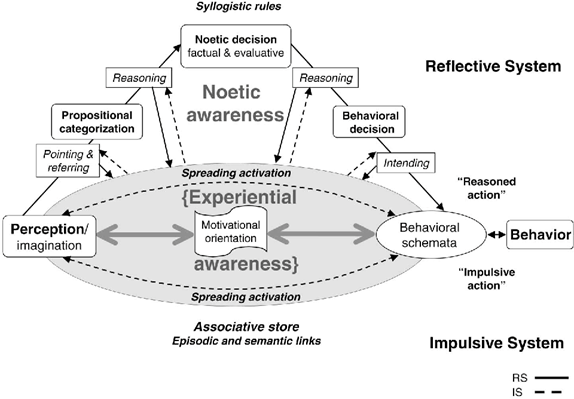
The complete reflexive-impulsive model thereby looks much less like a Rube Goldberg Machine than the original model. It is more flexible and more complicated, which made me view the model as more realistic. Still, a key similarity with the Rube Goldberg Machine remains: input is processed into output by a set of components that all have a specific function. It is the components that ‘do the job’. For a scientific study of the model, one would want to understand the causal architecture of the model by isolating specific components and carefully determining their function. For the case of the complete reflexive-impulsive model, the inclusion of the interactions has made this even more difficult than it was for the original reflexive-impulsive model. Although I was initially quite enthusiastic about such more complicated models, the feeling remained that there was something ‘off’. Specifically, the two concerns I had in my third bachelor year reappeared in my thinking.
First, to further improve psychological models, it seemed to me that we could add components in an infinite regression. I was not the first one with that thought. In 1993, the year I was born, Guy van Orden asked my promoter Anna Bosman (student, back then): ‘Did you ever come across a variable in psychology that does not interact with another one?’ (Bosman et al., 2013). In the case of a psychological model like the reflexive-impulsive model, one may thus wonder if more components and interactions should be added to make the ‘complete model’ even more complete. Second, before starting the research master I believed that learning more would help me to integrate the various results and theories in psychological science (at least in my own understanding). That did not appear to be the case in the research master. The more I learned, the further I moved away from such an integration. More knowledge led only to more divergence in my understanding of psychological phenomena.
At this point in my research master, my scientific interest was exhibiting quite some instability. One day I could be really enthusiastic about a way forward for psychological science, and another day extremely disappointed when I discovered a new problem with it. This instability came to a tipping point in the course Dynamics of Complex Systems taught by Fred Hasselman and Maarten Wijnants. With all things I learned in this fascinating course, my ideas about what was ‘off’ with typical psychological science became more and more explicit following from the assumption of component-dominant dynamics (Van Orden et al., 2003).
Component-dominant dynamics
A component-dominant system is one in which a set of specific time-invariant components dominates the dynamics of the system. It has a hard-assembled causal architecture in which the same finite set of components mediates the relation between input and output always in the same manner (Wallot & Kelty-Stephen, 2017). A Rube Goldberg machine is thus a typical component-dominant system. Methodologically, component-dominance implies that the variance of a measurement can be partitioned in smaller parts which can be explained by independent components. Component-dominance thus also allows parallel, instead of serial, contributions of components, as long as they are independent from one another (a jigsaw puzzle is thus also a metaphor for a component-dominant explanation; Olthof et al., 2023). Because of the assumption of a hard-assembled causal architecture consisting of a finite set of components, component-dominance promises the type of integration of research results that I had been longing for during my education. Component-dominant explanations should in principle be as easy to connect to each other as two Rube Goldberg machines.
Component-dominance had been the background assumption of all the psychological box-and-arrow models that I learned so far. Moreover, component-dominance underlies the methodology of empirical studies in psychology. Statistically, the component-dominant approach implies independent and identically distributed data points, as one assumes in the general linear model (GLM; Wallot & Kelty-Stephen, 2017). This assumption allows for statistical isolation of components. Variability, both between- and within-persons is regarded as random noise in the component-dominant view and should be minimized. Further, the relationship between a component and the output should be the same for every individual (homogeneity) and be time-invariant (stationarity), an assumption known as ergodicity (Molenaar, 2004). Component-dominance thus implies group-to-individual generalizability (Fisher et al., 2018). In practice, component-dominant research thus aims to explain psychological phenomena by statistically isolating causal components with group-level research designs and the GLM, whilst ignoring individual differences and variation over time.
Component-dominant research has its merit as it has led to the identification of relevant factors in psychological phenomena (which often turned out to be many) as well as the development of useful methodology such as experimental designs, randomized-controlled trails, and statistics. But when the assumptions of the component-dominant approach were made explicit during the course Dynamics of Complex Systems, I realized that all my concerns were related to limitations of the component-dominant framework. The lack of convergence between different models and results as well as the possible ad infinite regression of components to be added made me belief that psychological science may have reached a limit of what component-dominant research can tell us. This belief was strengthened by the evolution of psychology’s replication crisis into a ‘theory crisis’, in which several critiques argued that the replication problem was related to the component-dominant nature of the research field (Bosman et al., 2013; Hasselman, 2015; Wallot & Kelty-Stephen, 2017). I was therefore very happy to learn about an alternative approach to psychological science in the Dynamics of Complex Systems course. This alternative approach was based on interaction-dominant dynamics.
Interaction-dominant dynamics
In the interaction-dominant perspective, the components that give rise to a psychological phenomenon should be understood as interdependent processes (i.e., processes that continuously interact with each other) that coordinate themselves following from the principles of self-organization (Olthof et al., 2023). This implies that the role specific factors play is not only determined by intrinsic features of these factors, but always also by the interactions with countless other processes within the person and its environment at a specific moment in time (Wallot & Kelty-Stephen, 2017). As these processes continuously change on multiple timescales, the contributions of specific processes are not stable and cannot be isolated. In interaction-dominant dynamics, it is therefore not possible to reduce a psychological phenomenon to a set of underlying components, as it is the interdependence between components that generates the phenomenon. This is similar to how a flock of birds is generated by the interactions between the birds, which cannot be understood by taking all birds from the sky and studying them in isolation.
Assuming interaction-dominance in psychological science thus implies that we cannot isolate causal effects of independent components by experimental manipulation or by statistical inference (van Geert, 2019). Also, without stable components, we can no longer assume group-to-individual generalizability. Consequently, interaction-dominant research is very different compared to component-dominant research. Initially it may seem that one has to give up quite a lot to transition from the component-dominant to the interaction-dominant paradigm. Still, as Fred and Maarten showed me in their course, the interaction-dominant paradigm also has a lot to offer by the use of theory and methods from the science of complex systems. Complex systems theory and its associated methods are not aimed at disentangling components in a system, but exploit the many interactions between all components to learn about general dynamic features of a certain system. I found this complex systems approach extremely fascinating and was eager to learn more. The learning process was far from gradual, as the lectures in the course and the papers that I read also confused me heavily, but in a very enjoyable manner. Overall, it felt like a totally different way of thinking opened up to me and I was terribly excited.
The return of psychopathology
For my research master thesis, I contacted Marieke van Rooij, as she was the only person at the ‘potential supervisor pitches’ who mentioned something about complex systems. She then recommend me to go to a symposium organized by Anna Lichtwarck-Aschoff called General Principles of Psychopathology and Clinical Change. The symposium featured complex systems approaches to psychopathology and clinical change which were completely new to me. Especially the lecture by Günter Schiepek was extremely fascinating. I understood almost nothing of it, but the general impression was mind-blowing: real-time interaction dynamics, chaos, computational models, phase transitions, attractors, daily assessment, idiographic methods, and clinical implication all put together in a talk of 30 minutes or so. Apparently, an interaction-dominant, complex systems based science of psychopathology and clinical change existed which already had clinical implications. My initial interest in psychopathology was revived. Too bad no-one told me about this in my bachelor education, I thought.
I was very excited when Anna and Marieke told me I could work with them and Günter for my master thesis and study (precursors of) transitions in daily self-ratings collected during psychotherapy. This work, which formed the basis of Chapter 6 of the thesis (Olthof et al., 2020), was based on hypotheses from transdisciplinary complexity science, especially from the field of ecology, which was another revival of an early interest. With all these pieces falling into place, I much enjoyed the year working on the research master project. Actually, I enjoyed it so much that I became very much interested in doing a PhD in psychopathology and clinical change based on the complex systems approach, which ended up doing with the supervision of Anna Lichtwarck-Aschoff, Fred Hasselman, Günter Schiepek and Anna Bosman. And that’s how I got into complexity science.
I thank Anna Bosman, Nina de Boer, Freek Oude Maatman, Anna Lichtwarck-Aschoff, Olga de Bont and Julia Machielsen for their feedback on earlier versions of this text.
References
Borsboom, D. (2013). Theoretical amnesia. Open Science Collaboration Blog. http://osc.centerforopenscience.org/category/misc6.html
Bosman, A. M. T., Cox, R. C. A., Hasselman, F., & Wijnants, M. L. (2013). From the role of context to the measurement problem: The Dutch connection pays tribute to Guy Van Orden. Ecological Psychology, 25(3), 240–247. https://doi.org/10.1080/10407413.2013.810091
Fisher, A. J., Medaglia, J. D., & Jeronimus, B. F. (2018). Lack of group-to-individual generalizability is a threat to human subjects research. Proceedings of the National Academy of Sciences, 115(27), E6106-E6115. https://doi.org/10.1073/pnas.1711978115
Hasselman, F. (2015). Beyond the boundary An analysis of verisimilitude and causal ontology of scientific claims Ætiologies of developmental dyslexia as a case in point. [Doctoral dissertation, Radboud University]. http://hdl.handle.net/2066/140654
Molenaar, P. C. (2004). A manifesto on psychology as idiographic science: Bringing the person back into scientific psychology, this time forever. Measurement, 2(4), 201-218. https://doi.org/10.1207/s15366359mea0204_1
Olthof, M., Hasselman, F., Strunk, G., van Rooij, M., Aas, B., Helmich, M. A., … & Lichtwarck-Aschoff, A. (2020). Critical fluctuations as an early-warning signal for sudden gains and losses in patients receiving psychotherapy for mood disorders. Clinical Psychological Science, 8(1), 25-35.
Olthof, M., Hasselman, F., Oude Maatman, F., Bosman, A. M., & Lichtwarck-Aschoff, A. (2023). Complexity theory of psychopathology. Journal of Psychopathology and Clinical Science, 132(3), 314.
Strack, F., & Deutsch, R. (2004). Reflective and impulsive determinants of social behavior. Personality and social psychology review, 8(3), 220-247.
Van Geert, P. L. C. (2019). Dynamic systems, process and development. Human Development, 63, 153–179. https://doi.org/10.1159/000503825
Van Orden, G. C., Holden, J. G., & Turvey, M. T. (2003). Self-organization of cognitive performance. Journal of experimental psychology: General, 132(3), 331.
Wallot, S., & Kelty-Stephen, D. G. (2017). Interaction-dominant causation in mind and brain, and its implication for questions of generalization and replication. Minds and Machines, 28, 353-374. https://doi.org/10.1007/s11023-017-9455-0